Monday, October 28, 2013

IPCC model global warming projections have done much better than you think

Global warming since 1990 has fallen within the range of IPCC climate model projections
IPCC Earth
Models that simulate the Earth's climate are constantly improving. Photograph: NASA/Corbis
The figure below from the 2013 Intergovernmental Panel on Climate Change (IPCC) report compares the global surface warming projections made in the 1990, 1995, 2001, and 2007 IPCC reports to the temperature measurements.
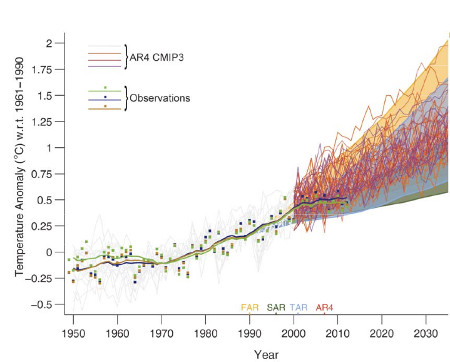
IPCC AR5 Figure 1.4.  Solid lines and squares represent measured average global surface temperature changes by NASA (blue), NOAA (yellow), and the  UK Hadley Centre (green).  The colored shading shows the projected range of surface warming in the IPCC First Assessment Report (FAR; yellow), Second (SAR; green), Third (TAR; blue), and Fourth (AR4; red).IPCC AR5 Figure 1.4. Solid lines and squares represent measured average global surface temperature changes by NASA (blue), NOAA (yellow), and the UK Hadley Centre (green). The colored shading shows the projected range of surface warming in the IPCC First Assessment Report (FAR; yellow), Second (SAR; green), Third (TAR; blue), and Fourth (AR4; red).
Since 1990, global surface temperatures have warmed at a rate of about 0.15°C per decade, within the range of model projections of about 0.10 to 0.35°C per decade. As the IPCC notes,
"global climate models generally simulate global temperatures that compare well with observations over climate timescales ... The 1990–2012 data have been shown to be consistent with the [1990 IPCC report] projections, and not consistent with zero trend from 1990 ... the trend in globally-averaged surface temperatures falls within the range of the previous IPCC projections."

What about the Naysayers?

In the weeks and months leading up to the publication of the final 2013 IPCC report, there has been a flood of opinion articles in blogs and the mainstream media claiming that the models used by the IPCC have dramatically over-predicted global warming and thus are a failure. This narrative clearly conflicts with the IPCC model-data comparison figure shown above, so what's going on?
These mistaken climate contrarian articles have all suffered from some combination of the following errors.

1) Publicizing the flawed draft IPCC model-data comparison figure

Late last year, an early draft of the IPCC report was leaked, including the first draft version of the figure shown above. The first version of the graph had some flaws, including a significant one immediately noted by statistician and climate blogger Tamino.
"The flaw is this: all the series (both projections and observations) are aligned at 1990. But observations include random year-to-year fluctuations, whereas the projections do not because the average of multiple models averages those out ... the projections should be aligned to the value due to the existing trend in observations at 1990.
Aligning the projections with a single extra-hot year makes the projections seem too hot, so observations are too cool by comparison."
In the draft version of the IPCC figure, it was simply a visual illusion that the surface temperature data appeared to be warming less slowly than the model projections, even though the measured temperature trend fell within the range of model simulations. Obviously this mistake was subsequently corrected.
This illustrates why it's a bad idea to publicize material in draft form, which by definition is a work in progress. That didn't stop Fox NewsRoss McKitrick in the Financial PostRoger Pielke Jr., the Heartland Institute, and Anthony Watts from declaring premature and unwarranted victory on behalf of climate contrarians based on the faulty draft figure.

2) Ignoring the range of model simulations

A single model run simulates just one possible future climate outcome. In reality, there are an infinite number of possible outcomes, depending on how various factors like greenhouse gas emissions and natural climate variability change. This is why climate modelers don't make predictions; they make projections, which say in scenario 'x', the climate will change in 'y' fashion. The shaded regions in the IPCC figure represent the range of outcomes from all of these individual climate model simulations.
The IPCC also illustrates the "multi-model mean," which averages together all of the individual model simulation runs. This average makes for an easy comparison with the observational data; however, there's no reason to believe the climate will follow that average path, especially in the short-term. If natural factors act to amplify human-caused global surface warming, as they did in the 1990s, the climate is likely to warm faster than the model average in the short-term. If natural factors act to dampen global surface warming, as they have in the 2000s, the climate is likely to warm more slowly than the model average.
When many model simulations are averaged together, the random natural variability in the individual model runs cancel out, and the steady human-caused global warming trend remains left over. But in reality the climate behaves like a single model simulation run, not like the average of all model runs.
This is why it's important to retain the shaded range of individual model runs, unlike Bjorn Lomborg in The AustralianJudith Curry in The AustralianBenny Peiser at GWPFRoger Pielke Jr.David Rose in the Mail on Sunday (copied by Hayley Dixon in The Telegraph), and Der Spiegel, all of whom only considered the model average.
This group all made an additional related third error as well.

3) Cherry Picking

Most claims that the IPCC models have failed are based on surface temperature changes over the past 15 years (1998–2012). During that period, temperatures have risen about 50 percent more slowly than the multi-model average, but have remained within the range of individual model simulation runs.
However, 1998 represented an abnormally hot year at the Earth's surface due to one of the strongest El NiƱo events of the 20th century. Thus it represents a poor choice of a starting date to analyze the surface warming trend (selectively choosing convenient start and/or end points is also known as 'cherry picking'). For example, we can select a different 15-year period, 1992–2006, and find a surface warming trend nearly 50 percent faster than the multi-model average, as statistician Taminohelpfully illustrates in the figure below.
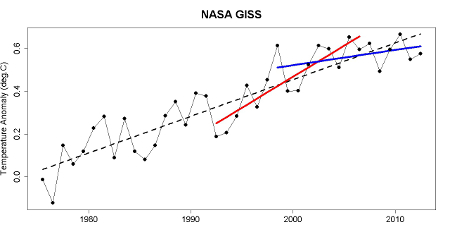
Fast warming trend 1992–2006, slow warming trend 1997–2012Global surface temperature data 1975–2012 from NASA with a linear trend (black), with trends for 1992–2006 (red) and 1998–2012 (blue).
In short, if David Rose wasn't declaring that global surface warming was accelerating out of control in 2006, then he has no business declaring that global surface warming has 'paused' in 2013. Both statements are equally wrong, based on cherry picking noisy short-term data.

IPCC models have been accurate

For 1992–2006, the natural variability of the climate amplified human-caused global surface warming, while it dampened the surface warming for 1997–2012. Over the full period, the overall warming rate has remained within the range of IPCC model projections, as the 2013 IPCC report notes.
"The long-term climate model simulations show a trend in global-mean surface temperature from 1951 to 2012 that agrees with the observed trend (very high confidence). There are, however, differences between simulated and observed trends over periods as short as 10 to 15 years (e.g., 1998 to 2012)."
The IPCC also notes that climate models have accurately simulated trends in extreme cold and heat, large-scale precipitation pattern changes, and ocean heat content (where most global warming goes). Models also now better simulate the Arctic sea ice decline, which they had previously dramatically underestimated.
All in all, the IPCC models do an impressive job accurately representing and projecting changes in the global climate, contrary to contrarian claims. In fact, the IPCC global surface warming projections haveperformed much better than predictions made by climate contrarians.
It's important to remember that weather predictions and climate predictions are very different. It's harder to predict the weather further into the future. With climate predictions, it's short-term variability (like unpredictable ocean cycles) that makes predictions difficult. They actually do better predicting climate changes several decades into the future, during which time the short-term fluctuations average out.
That's why climate models have a hard time predicting changes over 10–15 years, but do very well with predictions several decades into the future, as the IPCC illustrates. This is good news, because with climate change, it's these long-term changes we're worried about:
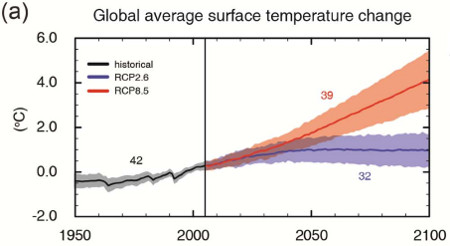
IPCC surface temperature change projectionsIPCC AR5 projected global average surface temperature changes in a high emissions scenario (RCP8.5; red) and low emissions scenario (RCP2.6; blue).

Sunday, October 20, 2013

Aftermath of global warming nature furious

India appears to be a creaking battleship struggling hard to come to terms with climate change. Not only has India become warmer than it was five decades ago but extreme weather events such as flooding, drought and cyclones are driving this battleship aground.
Some of the deadliest tropical cyclones in history have emanated from the Bay of Bengal triggering speculation that these could well be linked to climate change, the most recent being cyclone Phailin which lashed the Odisha coast early October.
This was preceded by heavy rainfall that struck Uttarakhand in mid-June causing rivers and glacial lakes to overflow, triggering massive landslides. This was preceded by an earthquake in Sikkim in 2011 which left several dead.
An analysis of extreme weather events caused by increasing heat hosted on the National Disaster Management Authority website, shows that extreme weather events have increased in the past three decades. The average number of extreme weather events on an annual basis has more than doubled from 140.8 in 1980-89 to 350.4 in 2000-10. The Indian Institute of Tropical Meteorology has also shown that much of India is warming.
Rising temperatures will affect tthe Indian monsoon. The Fifth UNFCCC report confirms our worst fears. The report states: ‘While monsoon winds are likely to weaken, monsoon precipitation is expected to intensify due to increase in atmospheric moisture. Monsoon may arrive earlier.
Monsoon retreat dates are likely to be delayed, resulting in the lengthening of the monsoon season.’ The report warns that greenhouse gas emissions  need to stay within 800 gigatonnes of carbon equivalent but humans have already used up around 530 GtC. The remaining 270 GtC is expected to be used up in the next two decades.
India wants the atmosphere to be shared equitably. But within the country, rampant deforestation, large-scale construction of hydroelectric dams and unregulated urbanisation is worsening the situation.
Environmentalists have warned that around 76 per cent of India’s coastline is prone to cyclones and tsunamis and the main protection against these is to extend mangrove forests. The first line of defence against cyclones has been destroyed just as increasing deforestation of the Himalayas has led to a sharp increase in landslides. Another 59 per cent of the country is vulnerable to quakes while huge tracts are prone to floods.
No wonder, India remains one of the most disaster-prone countries in the world with its 1.2 billion people increasingly vulnerable to extreme weather events.
How is this creaking battleship going to be turned around? “We do not have a credible climate change policy,” pointed out Dr Ravi Chellam, an environmental biologist. Unless an environment blueprint is prepared and implemented, no amount of crying wolf is going to help.

Wednesday, October 16, 2013

Five Steps America Must Take Now to Combat Climate Change


The government shutdown, even after it ends, will slow much of the president's second-term agenda items. Obamacare isn't the only policy on the political chopping block.  Despite reports by U.N. scientists and Nature researchers this month that the planet's climate is still warming, ice is still melting, seas are still rising and humans are still certainly to blame, the President's Climate Action Plan — which aims to reduce greenhouse gas emissions here at home, assist communities in adapting to the unavoidable impacts of climate change and increase United States leadership in spurring global climate action — is also getting stuck coming out the gate.
To its credit, the Obama administration, cognizant of congressional gridlock, designed its strategy around executive action, using powers already granted under laws such as the Clean Air Act. What we know, however, according to the Intergovernmental Panel on Climate Change, is that the U.S. must cut emissions more than twice as much as the president's plan, in a best-case-scenario, in order to stave off the worst impacts of climate change.
It is clear that the U.S. must propose a bolder plan to position the world to hold a temperature increase below 2 degrees Celsius, the widely agreed "safe-zone" that prevents climate catastrophe. The only way to lower greenhouse gas pollution in the near term and ensure deep cuts in the long term is through market-based solutions, which require Congressional approval.
President Obama realizes this. When he introduced his climate plan, he admitted that "we've got more to do," and declared that he is "willing to work with anyone to make a [bipartisan, market-based solution to climate change] happen," saying that climate change is a "challenge that does not pause for partisan gridlock."
We could not agree more. For this reason, we are recommending the top five market-based solutions that Congress can implement to align our climate policy with what the world's best scientists say is necessary.
First, we must implement a Greenhouse Gas Fee that puts a price on climate change-causing emissions from all energy sources. This is the most effective single policy tool to fight climate change. Both parties, who are currently trying to tamp down our debt problem, should be pleased with the revenue-raising opportunities here.  This is money we can use to fund research and development, electrical grid enhancements, incentivize smart land-use practices and protect vulnerable communities from climate and price changes.
Depending on the design of the fee, implementing this policy tool could reduce overall U.S. greenhouse gas emissions from 2005 levels by 18 to 32 percent in 2020 and 50 to 95 percent in 2050, according to a new report, "The Plan: How the U.S. Can Help Stabilize the Climate and Create A Clean Energy Future."
Second, we need to establish an independent, government-backed National Green Bank that will provide greater certainty for renewable energy investors at no net cost to the American taxpayer. Greater certainty means lower borrowing rates, which will decrease the price of clean energy. The Coalition for Green Bank estimates that a National Green Bank can cut clean energy borrowing costs in half, create more than a million new jobs and save more oil than we currently import from Saudi Arabia. Not unlike the National Infrastructure Reinvestment Bank, proposed by then-Sens. Chuck Hagel and Christopher Dodd in 2007 and later backed by President Obama in 2008, a Green Bank would ensure that America's energy infrastructure remains innovative, sustainable and resilient from petro-politics.  New York and Connecticut are already doing this at the state level. We must now do it at the federal level.
Third, we should increase investments in public transportation by $1.5 billion per year, which would double ridership growth, according to the Department of Transportation. Ninety-seven percent of U.S. transportation energy use is petroleum based.  This is unsustainable.  Further research and development of alternative technologies that would provide clean alternatives for the transportation sector — such as advanced batteries, hydrogen fuels, and cellulosic biofuels — is also necessary. The Department of Transportation also estimated that "if significant advances were to occur in battery technology" total transportation related emissions could be reduced by 26 to 30 percent in 2050.
Fourth, we must repeal the exemptions from the Clean Air Act, the Clean Water Act, the Safe Drinking Water Act and other environmental regulations that put hydraulic fracturing at an unfair advantage relative to other energy sources that play by the rules. In conjunction with a Greenhouse Gas Fee, eliminating these loopholes will ensure that natural gas production is responsible for the impacts of its pollution and competes fairly with all other energy sources. The negative externalities associated with production — especially the climate impacts of leakages of the powerful greenhouse gas methane — must ultimately be accounted for by the industry.
Finally, let's scrap fossil fuel subsidies. While not all of these subsidies are unnecessary (indeed, many low-income Americans rely on the Home Energy Assistance Program to help pay for heating bills), the most wasteful ones should be eliminated. This will have no impact on gas prices and will raise $40 billion of revenue over the next 10 years.
 More importantly, reducing our fossil fuel subsidies here at home will send an important international signal for other nations to follow our lead. While U.S. emissions won't decline substantially with fossil fuel subsidy elimination, there exists large reduction potential around the world should governments join with us and engage in responsible subsidy reform. We must lead the way.
The supposed counter-argument to all of this is that these policies will be too costly to our economy. While initial increases in capital investments are needed, the technologies required to transition to a clean energy economy are already becoming cost-competitive and energy efficiency improvements and new innovations will further reduce costs. When you factor in avoided costs from climate change damages (a 2012 study estimates that inaction on climate change will cost the U.S. 2.1 percent of GDP by 2030 — more than our current annual spending on Medicaid) it is clear that the cost of inaction is far greater.
President Obama's Climate Action Plan represents a step in the right direction, but we must acknowledge it as such. True climate leadership can only occur with the support of Congress. It is clear that politics is all that stands in our way—the technologies and policies exist to ensure a better future. By getting behind these five tools, the American people, and especially President Obama, can put pressure on our elected officials to transition our economy off of fossil fuels and send a strong signal to international leaders that we're ready to take on the climate challenge. What happens next is up to you.
Michael Shank, Ph.D., is the Director of Foreign Policy at the Friends Committee on National Legislation and Adjunct Faculty at George Mason University's School for Conflict Analysis and Resolution. 

Matt Lichtash is a co-author of "The Plan: How The U.S. Can Help Stabilize The Climate And Create A Clean Energy Future."

Monday, October 14, 2013

Global warming will increase intensity of El Nino, scientists say

Scientists say they are more certain than ever about the impact of global warming on a critical weather pattern.
The El Nino-Southern Oscillation (ENSO) occurs in the Pacific Ocean but plays an important part in the world's climate system.
Researchers have until now been unsure as to how rising temperatures would affect ENSO in the future.
But this new study suggests that droughts and floods driven by ENSO will be more intense.

Start Quote

This study finds that both wet and dry anomalies will be greater in future El Nino years”
Dr Wenju CaiCSIRO
The ENSO phenomenon plays a complicated role in the global weather system.
The El Nino part of the equation sees a warming of the eastern and tropical Pacific, while its cooler sister, La Nina, makes things chillier in these same regions.
Impacts across the world
Like water in a bathtub, the warmer or cooler waters slosh back and forth across the Pacific Ocean. They are responsible for rainfall patterns across Australia and the equatorial region, but their effects are also felt much further away.
During the Northern Hemisphere winter, for example, you can get more intense rainfall over the southern part of the US in a warmer El Nino phase.
For years, scientists have been concerned about how this sensitive weather system might be changed by rising temperatures from global warming.
floodsThis flooding in California in the 1980s was put down to El Nino impacts
Now, in this new paper, published in the journal Nature, researchers give their most "robust" projections yet.
Using the latest generation of climate models, they found a consistent projection for the future of ENSO.
According to the lead author, Dr Scott Power from the Australian Bureau of Meteorology, global warming interferes with the way El Nino temperature patterns affect rainfall.
"This interference causes an intensification of El Nino-driven drying in the western Pacific and rainfall increases in the central and eastern equatorial Pacific," he said.
Models in agreement
According to Dr Wenju Cai, a scientist at the Commonwealth Scientific and Industrial Research Organisation (CSIRO), who was not involved with the study, the paper is "significant".
"Up until now, there has been a lack of agreement among computer models as to how ENSO will change in the future," he explained.
"This paper is significant in that there is stronger agreement among different climate models in predicting the future impact.
"This study finds that both wet and dry anomalies will be greater in future El Nino years. This means that ENSO-induced droughts and floods will be more intense in the future."

Monday, October 7, 2013

University of Reading scientist's warning over global warming

 “All the evidence makes it clear that leaving the issue of climate change for future generations to deal with is a phenomenally high-risk option."
University of Reading scientists have warned the world’s governments not to ignore the findings of the most comprehensive assessment on climate change.
The Fifth Assessment Report from the UN’s Intergovernmental Panel on Climate Change (IPCC) was published at a major conference in Stockholm last month.
The landmark report finds that scientists are 95 per cent sure that the humans are the ‘dominant cause’ of global warming since the 1950s.
Seventeen of The University of Reading’s climate scientists were among hundreds contributing to the report, which was led by 259 authors from 39 countries and which has taken three years to produce.
One of the lead authors was Professor Rowan Sutton, director of climate research at the UK National Centre for Atmospheric Science (NCAS) based at the university’s Department of Meteorology.
On the university’s contribution, Prof Sutton said: “The very substantial roles of Reading scientists in the production of the IPCC report is a direct reflection of the strength and breadth of climate change-related research at The University of Reading.
“Brought together under the umbrella of the Walker Institute, Reading’s Department of Meteorology is a key focus, but many other departments are also making very substantial contributions to climate science.”
The report found that global warming was unequivocal, with the atmosphere and ocean warming, the amount of snow and ice diminishing, sea levels rising and the concentrations of greenhouse gases rising.
Each of the previous three decades has been successively warmer at the Earth’s surface than any preceding decade since 1850 with the last likely to be the warmest period in 1,400 years in the Northern Hemisphere.
Over the last two decades the Greenland and Antarctic ice sheets have lost mass, glaciers have shrunk almost worldwide and Arctic sea ice and Northern Hemisphere snow cover has decreased.
The rate of sea level rise since the mid-19th Century has been larger than the mean rate during the previous two millennia.
The report found that human influence on the climate system was clear and evident from increasing concentrations of greenhouse gas which will continue to impact on all aspects of the climate system. 
Prof Sutton said: “All the evidence makes it clear that leaving the issue of climate change for future generations to deal with is a phenomenally high-risk option.
“The report shows that the evidence of human activities affecting climate is increasingly widespread and stronger than ever.
“It shows there is a very substantial risk of exceeding 2C warming, relative to pre-industrial climate, by the end of the century.
“Only under a very ambitious scenario for reducing greenhouse gas emissions is a warming of more than 2C considered to be unlikely.
“This report provides the evidence that governments need to take tough decisions on climate change policy.
“I hope they will read it carefully and take seriously all its findings.
“An increasing frequency of hot days, and intense rainfall events, are some of the changes that could affect Britain.
“Working out more of the details is a major focus of our research.”

Saturday, October 5, 2013

New Global Warming Source: Oceans

The world's oceans absorb much of the carbon dioxide that humans pump into the atmosphere, which comes largely from the burning of fossil fuels. But soaking up all of that carbon is slowly changing the chemistry of the oceans, which could amplify the effects of global warming in decades to come.
That's the conclusion reached in a study released last week in the science journal Nature Climate Change, which found that as the oceans become more acidic, they cause tiny marine organisms to release less of a gas that helps protect Earth from the sun's radiation.
The gas is produced by tiny, single-celled animals called phytoplankton, which drift throughout the seas and form the base of the food chain for all larger marine life. They release a compound called dimethylsulfide (DMS), some of which floats into the atmosphere and clumps with other molecules to create atmospheric sulfur, which combines with other aerosols and water vapor to make clouds.
Clouds play a role in the Earth's albedo -- its ability to reflect solar radiation back into space from surfaces like snow, ice and clouds -- which means they also play a role in cooling the planet. But the scientists who published the study found that as the oceans become more acidic, phytoplankton release less DMS.
"On a global scale, a fall in DMS emissions due to acidification could have a major effect on climate, creating a positive-feedback loop and enhancing [global] warming," the journal Nature notes in a press release announcing the study.
They have such a big impact because phytoplankton are the biggest natural source of DMS emissions, Time Magazine notes. By the end of the century, the world's oceans are expected to release about 18 percent less DMS than before the start of the Industrial Revolution some 150 years ago.
With less DMS in the atmosphere, the study's authors say, sunlight that could have been reflected back into space would instead make it all the way to Earth's surface.
If the concentration of carbon dioxide in the atmosphere doubles by 2100, as many models project, ocean acidification could contribute as much as 0.8 degrees to the expected rise in global temperatures by then of between 3.6 and 8.1 Fahrenheit degrees.
"We were surprised that the effect was so large," Katharina Six of Germany's Max Planck Institute for Meteorology told New Scientist. "It certainly speeds up the warming."
Read the full study in Nature Climate Change.

Mercury in Seafood May Rise with Global Warming

High levels of methylmercury are known to accumulate in the fatty tissues of large ocean-going fish such as tuna, swordfish and marlins. Though most people do not eat enough of these types of fish to result in mercury poisoning, pregnant women are advised to restrict their intake because of the risk to the fetus.
Now it looks like climate change may make the consumption risk even greater.
Biologists observed higher accumulation of methylmercury in killifish, a small fish, as temperatures increased both in the wilderness of Maine and in laboratories.
The contamination levels in the fish may increase with temperature because the metabolism of the tiny fish speeds up in warmer water, according to the recent research published in PLOS ONE. The cold-blooded fish eat more and thereby pick up more methylmercury from the environment.
Coal-burning power plants produce most of the mercury pollution in the atmosphere. When the mercury falls back to Earth’s surface it lands either in the ocean or on land where it can be washed into lakes, streams, and eventually the ocean. Certain bacteria transform the mercury into methylmercury, a more toxic form. After this bacterial conversion, the methylmercury enters the food chain, accumulating in fatty tissues. When people worry about mercury in their fish and other seafood, it is actually this bacterially-altered form of methylmercury.
In the lab, the biologists conducting the study replicated the increasing temperatures likely to occur as climate change continues. The highest levels of mercury contamination occurred in the fish in the warmest water (27 degrees Celsius or 80°F). They also fed the fish mercury-enriched food. “The fish in warmer waters ate more but grew less and had higher methylmercury levels in their tissues,” the authors reported in a press release.
In nature, killifish from different salt marsh pools on the coast near Wells, Maine, served to also replicate the effects of varying degrees of temperatures. The water in some pools reached higher temperatures than others, ranging from 18 to 22 degrees Celsius (65°F to 72°F). Once again, the warmer pools held fish with greater levels of mercury, even though they were only feeding on insects, worms and other natural food sources.
Many larger fish feed on the killifish, varieties of which live around the globe. Mercury in the smaller fish transfers to the larger fish. Mercury continues to build up in the food web, until it reaches the top predator on the planet, us.