Saturday, June 1, 2013

CFCs, Not Carbon Dioxide, Caused Global Warming - Paper

Chlorofluorocarbons (CFCs), known to deplete ozone, are also to blame for global warming since the 1970s, according to a paper in the International Journal of Modern Physics B.
The statistical analysis found that CFCs are the key driver in global climate change, rather than carbon dioxide (CO2) emissions, which the author says would explain why temperature has not continued to rise as CO2 has - CFCs have gone down a lot.

The findings are based on statistical analyses of observed data from 1850 up to the present time, the cosmic-ray-driven electron-reaction (CRE) hypothesis of ozone depletion by Professor Qing-Bin Lu, a professor of physics and astronomy, biology and chemistry in Waterloo's Faculty of Science, and his previous research into Antarctic ozone depletion and global surface temperatures.
"Conventional thinking says that the emission of human-made non-CFC gases such as carbon dioxide has mainly contributed to global warming. But we have observed data going back to the Industrial Revolution that convincingly shows that conventional understanding is wrong," said Lu. "In fact, the data shows that CFCs conspiring with cosmic rays caused both the polar ozone hole and global warming.
"Most conventional theories expect that global temperatures will continue to increase as CO2 levels continue to rise, as they have done since 1850. What's striking is that since 2002, global temperatures have actually declined – matching a decline in CFCs in the atmosphere. My calculations of CFC greenhouse effect show that there was global warming by about 0.6 °C from 1950 to 2002, but the earth has actually cooled since 2002. The cooling trend is set to continue for the next 50-70 years as the amount of CFCs in the atmosphere continues to decline."
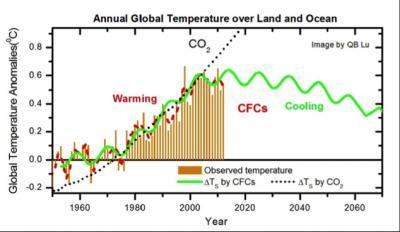


Chlorofluorocarbons are to blame for global warming since the 1970s and not carbon dioxide, according to a paper in the International Journal of Modern Physics B this week. This graph projects the predicted path of global temperatures and sees a decline as a result of depletion of CFC's in the atmosphere. Credit: Qing-Bin Lu, University of Waterloo
"It was generally accepted for more than two decades that the Earth's ozone layer was depleted by the sun's ultraviolet light-induced destruction of CFCs in the atmosphere," he said. "But in contrast, CRE theory says cosmic rays – energy particles originating in space – play the dominant role in breaking down ozone-depleting molecules and then ozone."
Lu's theory has been confirmed by ongoing observations of cosmic ray, CFC, ozone and stratospheric temperature data over several 11-year solar cycles. "CRE is the only theory that provides us with an excellent reproduction of 11-year cyclic variations of both polar ozone loss and stratospheric cooling," said Professor Lu. "After removing the natural cosmic-ray effect, my new paper shows a pronounced recovery by ~20% of the Antarctic ozone hole, consistent with the decline of CFCs in the polar stratosphere."
By proving the link between CFCs, ozone depletion and temperature changes in the Antarctic, Professor Lu was able to draw almost perfect correlation between rising global surface temperatures and CFCs in the atmosphere.
"The climate in the Antarctic stratosphere has been completely controlled by CFCs and cosmic rays, with no CO2 impact. The change in global surface temperature after the removal of the solar effect has shown zero correlation with CO2 but a nearly perfect linear correlation with CFCs - a correlation coefficient as high as 0.97."
Data recorded from 1850 to 1970, before any significant CFC emissions, show that CO2 levels increased significantly as a result of the Industrial Revolution, but the global temperature, excluding the solar effect, kept nearly constant. The conventional warming model of CO2, suggests the temperatures should have risen by 0.6°C over the same period, similar to the period of 1970-2002.
The analyses indicate the dominance of Lu's CRE theory and the success of the Montreal Protocol on Substances that Deplete the Ozone Layer.
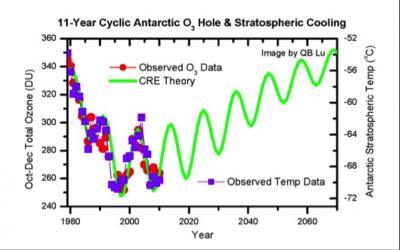


Graph showing correlation between observed temperature data and Professor Qing-Bin Lu's cosmic-ray-driven electron-reaction (CRE) hypothesis about ozone depletion. Credit: Qing-Bin Lu, University of Waterloo
"We've known for some time that CFCs have a really damaging effect on our atmosphere and we've taken measures to reduce their emissions," Professor Lu said. "We now know that international efforts such as the Montreal Protocol have also had a profound effect on global warming but they must be placed on firmer scientific ground."
"This study underlines the importance of understanding the basic science underlying ozone depletion and global climate change," said Terry McMahon, dean of the faculty of science. "This research is of particular importance not only to the research community, but to policy makers and the public alike as we look to the future of our climate."
Lu's paper, "Cosmic-Ray-Driven Reaction and Greenhouse Effect of Halogenated Molecules: Culprits for Atmospheric Ozone Depletion and Global Climate Change", also predicts that the global sea level will continue to rise for some years as the hole in the ozone recovers increasing ice melting in the polar regions. 
"Only when the effect of the global temperature recovery dominates over that of the polar ozone hole recovery, will both temperature and polar ice melting drop concurrently," says Lu.  "Conventional thinking says that the emission of human-made non-CFC gases such as carbon dioxide has mainly contributed to global warming. But we have observed data going back to the Industrial Revolution that convincingly shows that conventional understanding is wrong. In fact, the data shows that CFCs conspiring with cosmic rays caused both the polar ozone hole and global warming."

The Effects of Global Warming

Global warming is expected to have far-reaching, long-lasting and, in many cases, devastating consequences for planet Earth.
For some years, global warming — the gradual heating of Earth's surface, oceans and atmosphere — was a topic of heated debate in the scientific community.
But the overwhelming consensus of researchers today is that global warming is real and is caused by human activity, primarily the burning of fossil fuels that pump carbon dioxide (CO2), methane and other greenhouse gases into the atmosphere.
Additionally, global warming is having a measurable effect on the planet right now.

Increase in average temperatures

One of the most immediate and obvious impacts of global warming is the increase in temperatures around the world. The average global temperature has increased by about 1.4 degrees Fahrenheit (0.8 degrees Celsius) over the past 100 years, according to the National Oceanic and Atmospheric Administration (NOAA).
Since recordkeeping began in 1895, the hottest year on record for the 48 contiguous U.S. states was 2012. Worldwide, 2012 was also the 10th-warmest year on record, according to NOAA. And nine of the warmest years on record have occurred since 2000.

Extreme weather events

Scientists have found that the number and severity of extreme weather events — record-breaking high or low temperatures, high rainfall events or intense storms — are an effective measure of climate change and global warming.
The U.S. Climate Extremes Index (CEI) was established in 1996 to track these events. The number of extreme weather events that are among the most unusual in the historical record, according to the CEI, has been rising over the last four decades, according to NOAA.
Scientists project that extreme weather events, such as heat waves, droughts, blizzards and rainstorms will continue to occur more often and with greater intensity due to global warming, according to Climate Central.

Shift in climate patterns

Climate models forecast that global warming will cause climate patterns worldwide to experience significant changes. These changes will likely include major shifts in wind patterns, annual precipitation and seasonal temperatures variations.
And because high levels of greenhouse gases in the atmosphere are likely to remain high for many years, these changes are expected to last for several decades or longer, according to the Environmental Protection Agency (EPA).
In the northeastern United States, for example, climate change is likely to bring increased annual rainfall, while in the Pacific Northwest, summer rainfall is expected to decrease.

Snow and ice

Since 1970, the area of snow cover in the United States has steadily decreased, according to the EPA, and the average temperature of permafrost (soil that's at or below freezing temperature) has grown warmer.
Arctic summer sea ice
Arctic sea ice at the end of melt season, 1981-2009
CREDIT: NSIDC
One of the most dramatic effects of global warming is the reduction in Arctic sea ice: In 2012, scientists saw the smallest amount of Arctic ice cover ever recorded. Most analyses project that, within a matter of years, the Arctic Sea will be completely ice-free during the summer months.
Glacial retreat, too, is an obvious effect of global warming. Only 25 glaciers bigger than 25 acres are now found in Montana's Glacier National Park, where about 150 glaciers were once found, according to the U.S. Geological Survey. A similar trend is seen in glacial areas worldwide.

Rising sea levels

Melting polar ice in the Arctic and Antarctic region, coupled with melting ice sheets and glaciers across Greenland, North America, South America, Europe and Asia, are expected to raise sea levels significantly.
Global sea levels have risen about 8 inches since 1870, according to the EPA, and the rate of increase is expected to accelerate in the coming years. If current trends continue, many coastal areas — where roughly half of the Earth's human population lives — will be inundated.
Researchers project that by 2100, average sea levels will be 2.3 feet higher in New York City, 2.9 feet higher at Hampton Roads, Va., and 3.5 feet higher at Galveston, Texas, the EPA reports.

Ocean acidification

As levels of atmospheric carbon dioxide (CO2) increase, the oceans absorb some of that CO2, which increases the acidity of seawater. Since the Industrial Revolution began in the early 1700s, the acidity of the oceans has increased about 25 percent, according to the EPA.
Because acids dissolve calcium carbonate, seawater that's more acidic has a deleterious effect on organisms with shells made of calcium carbonate, such as corals, mollusks, shellfish and plankton.
If current ocean acidification trends continue, coral reefs are expected to become increasingly rare in areas where they are now common, including most U.S. waters, the EPA reports.

Plant and animal impacts

The effects of global warming on the Earth's ecosystems are expected to be profound and widespread. Many species of plants and animals are already moving their range northward or to higher altitudes as a result of warming temperatures, according to a report from the National Academy of Sciences.
CREDIT:Drought via Shutterstock
Additionally, migratory birds and insects are now arriving in their summer feeding and nesting grounds several days or weeks earlier than they did in the 20th century, according to the EPA.
Warmer temperatures will also expand the range of many disease-causing pathogens that were once confined to tropical and subtropical areas, killing off plant and animal species that formerly were protected from disease.
These and other impacts of global warming, if left unchecked, will likely contribute to the disappearance of up to one-half of the Earth's plants and one-third of animals from their current range by 2080, according to a 2013 report in the journal Nature Climate Change.

Social impacts

As dramatic as the effects of climate change are expected to be on the natural world, the projected changes to human society may be even more devastating.
Agricultural systems will likely be dealt a crippling blow: Though growing seasons in some areas will expand, the combined impacts of drought, severe weather, lack of snowmelt, greater number and diversity of pests, lower groundwater tables and a loss of arable land could cause severe crop failures and livestock shortages worldwide.
This loss of food security might, in turn, create havoc in international food markets and could spark famines, food riots, political instability and civil unrest worldwide, according to a number of analyses from sources as diverse as the U.S Department of Defense, the Center for American Progress and the Woodrow Wilson International Center for Scholars.
The effect of global warming on human health is also expected to be serious: The American Medical Association has reported an increase in mosquito-borne diseases like malaria and dengue fever, as well as a rise in cases of chronic conditions like asthma, are already occurring, most likely as a direct result of global warming.
Many of these expected impacts are the result of exhaustive scientific research and climate models, and the fact that most of them are already being observed gives additional credibility to the projected effects of global warming and climate change.

Is More Global Warming Hiding in the Oceans?

The HMS Challenger set sail 135 years ago. It was the world's first scientific survey of ocean life. But, the HMS Challenger also studied ocean temperatures along the way by dropping thermometers attached to Italian hemp ropes that stretched hundreds of meters deep — an effort that has been used as a baseline for global warming in oceans since pre-industrial times.
Now, according to a new study, U.S. and Australian researchers have combined the work of the HMS Challenger with modern-era climate science models — and have some surprising results. The study found we may be significantly under-estimating global warming's impact and heat content in the oceans; and, sea level rise from global warming seems to be split 60/40, with 40 percent coming from expansion of sea water caused by warming, and the remaining 60 percent coming from melting ice sheets and glaciers.
Thermometer readings in light of modern supercomputer climate models say it provides further confirmation of human-produced global warming over the past century.
"Our research revealed warming of the planet can be clearly detected since 1873 and that our oceans continue to absorb the great majority of this heat," said Will Hobbs, the study's lead author and a researcher at the University of Tasmania's Institute for Marine and Antarctic Studies. "Currently, scientists estimate the oceans absorb more than 90 percent of the heat trapped by greenhouse gases, and we attribute the global warming to anthropogenic causes."
The HMS Challenger expedition ran from 1872 to 1876, and was the world's first global scientific survey of life beneath the ocean surface. But, while it wasn't part of its central research mission, the Challenger also dropped thermometers deep into the ocean at different points. More than a century later, researchers used state-of-the-art climate models to get a more accurate picture of how the world's oceans have changed since the Challenger's voyage.
"The key to this research was to determine the range of uncertainty for the measurements taken by the crew of the Challenger," said Josh Willis, a study co-author who is a climate scientist at NASA's Jet Propulsion Laboratory. "After we had taken all these uncertainties into account, it became apparent that the rate of warming we saw across the oceans far exceeded the degree of uncertainty around the measurements. So, while the uncertainty was large, the warming signal detected was far greater."
Because it was the first expedition of its kind, there were a number of uncertainties around the HMS Challenger expedition. For instance, the Challenger could only drop thermometers in a limited number of areas in oceans . As it turns out, some of the places it chose — modern science now knows — are places that are warmer than usual.
The Challenger also could only guess about depths for the ropes that held the thermometers — there were no unmanned submersibles in those days — and they also could only guess at the natural variations in temperatures that could occur in different ocean regions during the expedition.
To account for these sorts of uncertainties with modern-era models, the researchers used the most conservative estimates they possibly could, taking into account the maximum possible variation from the uncertainties. Even taking this approach, the researchers found that global warming has clearly occurred in the world's oceans and is likely higher than what we know.
"Because we took the most conservative outcome, we are likely to have underestimated the true temperature rise," said Hobbs. "A simple analysis of our results suggests we may have underestimated the warming by as much as 17 percent. In fact, many of the stations most prone to bias were in the Eastern Pacific — a region showing one of the strongest ocean warming trends — so the true warming may be even larger than that."
While discovering that there was an increase in warming in ocean temperatures in the past century, the researchers were also able to clearly show the amount of thermal expansion in sea level rise in the oceans before the 1950s. Prior to this research, climate models offered the only way to estimate the change.
"This research adds yet another suite of compelling data that shows human activity continues to have a dramatic influence on the Earth's climate," Hobbs said.
This research on ocean heat content comes at a critical moment in the discussion of global warming. A leading climate scientist, Kevin Trenberth, recently wrote in a blog post for The Conversation that we may be vastly under-estimating just how much global warming is hiding in the world's oceans — and, that we may need to re-define the way we think about global warming.
"Rising surface temperatures are just one manifestation. Melting Arctic sea ice is another. So is melting of glaciers and other land ice that contribute to rising sea levels. Increasing the water cycle and invigorating storms is yet another," wrote Trenberth, who is a senior scientist at the National Center For Atmospheric Research in Boulder, Colorado.
"But, most (more than 90 percent) of the energy imbalance goes into the ocean, and several analyses have now shown this. But even there, how much warms the upper layers of the ocean, as opposed to how much penetrates deeper into the ocean where it may not have much immediate influence, is a key issue," he continued. [Surprising Depth to Global Warming's Effects]
Trenberth and some of his colleagues recently published a new analysis of their own which shows that, in the past decade, roughly 30 percent of global warming heat may be hiding below 2,000 feet in the world's oceans — essentially, in the bottom half of most of the oceans where very little observational research has been done. That's a significant analysis — because there has been virtually no research on missing heat at the deepest depths of the world's oceans (below 700 meters).
"The cause of the shift is a particular change in winds, especially in the Pacific Ocean where the subtropical trade winds have become noticeably stronger, changing ocean currents and providing a mechanism for heat to be carried down into the (deep) ocean," Trenberth wrote. "This is associated with weather patterns in the Pacific, which are in turn related to the La Niña phase of the El Niño phenomenon."
Trenberth predicted that some of this "missing heat" will return at some point — with long-term consequences.
"Some of the penetration of heat into the depths of the ocean is reversible, as it comes back in the next El Niño," he wrote. "But a lot is not; instead it contributes to the overall warming of the deep ocean. This means less short-term warming at the surface, but at the expense of greater long-term warming, and faster sea levels rise. So this has consequences."
But one thing is abundantly clear, Trenberth wrote. Despite the ups and downs of ocean heat, the La Niña / El Niño cycles and solar cycles that impact surface temperature from year to year, global warming is here to stay.
"The past decade is by far the warmest on record," he wrote. "Human induced global warming really kicked-in during the 1970s, and warming has been pretty steady since then."