Sunday, December 29, 2013

Message In A Bottle Found In Arctic Glacier Ultimately Reveals Global Warming In Region (PHOTO)

More than half a century ago, on July 10, 1959, American glaciologist and explorer Paul T. Walker was working in a remote region of the Canadian Arctic, the Los Angeles Times reports. In a quirky stroke of genius, Walker left a handwritten note to any scientists who might come behind him, and he stuck the message in a bottle under a pile of rocks.
"To Whom it May Concern: This and a similar cairn 21.3 feet to the west were set on July 10, 1959," the note states. "The distance from this cairn to the glacier edge about 4 ft. from the rock floor is 168.3 feet."
(Story continues below)
messgae in a bottle
Walker hoped that anyone who found the note might take new measurements and send them to his lab at Ohio State University, the Times reports. Sadly, Walker suffered a stroke mere weeks after he left the note and died a few months later. But 54 years later, his scientific mission lives on thanks to researchers who uncovered the message in a bottle.
Dr. Warwick F. Vincent, director of the Center for Northern Studies at Laval University in Quebec City, revealed the find earlier in December and said reading the famous names of Walker and his colleague Albert Crary gave him goosebumps.
Vincent, a biologist, and his colleague Denis Sarrazin found the note over the summer in a very remote area near the edge of a glacier, he told GrindTV Outdoor.
“It’s a story about climate change, but it is also a story about the incredibly brave and strong men who worked in this extreme high Arctic environment in the 1950s—back before GPS and sat phone technology,” Vincent told the outlet. “This is the most remote part of North America, and the coldest coastal zone (average temperature -18C). This also makes the evidence of substantial glacial retreat of great interest.”
The pair carried out Walker's wish, measuring the distance to the glacier in question, just as Walker had done decades earlier. Vincent and Sarrazin's measurement revealed that the glacier had retreated 233 feet since 1954.
While the effect of global warming on glaciers is not a new concept, Vincent told The Huffington Post the discovery is still significant.
"The substantial retreat of the glacier, based on our measurement on 18 July 2013 relative to that by Paul Walker on 10 July 1959, is not especially surprising given that glacier retreat as a consequence of global warming has been well documented at many places around the world," Vincent explained via email. "But northern Ellesmere Island has one of the world’s coldest coastal climates, with average air temperatures that are similar to coastal Antarctica (where I have worked previously), and glacial melting might be less expected in such a place of extreme cold."
Given the fact that there is still such noticeable loss in glacial ice, this special message should be heeded by scientists around the world, Vincent added.
"Paul Walker’s message from the past is a wake-up call to how fast our global climate is already changing, and it signals much larger changes in the future that may affect us all," he said.

Monday, November 25, 2013

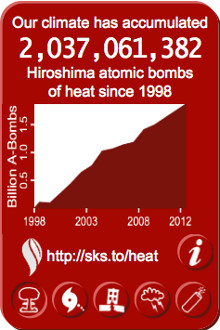
New widget counts global warming happening at 4 Hiroshima atomic bombs per second

Global warming is accumulating in the Earth's climate system at a rate equivalent to about 4 Hiroshima atomic bomb detonations, 2 Hurricane Sandys, or 4 magnitude 6.0 earthquakes per second.
The amount of energy building up on Earth due to human-caused global warming can be difficult to picture. 250 trillion Joules per second sounds like a lot, but what does that mean in terms people can more easily visualize? This widget, created by Bob Lacatena at Skeptical Science, tries to do just that.
Screenshot of the global warming widgetScreenshot of the global warming widget
The widget can be installed on most blogs and is customizable, allowing users to choose the color, size, button style, and starting year. For example, since 1998, the Earth's climate has accumulated over 2 billion Hiroshima atomic bombs worth of energy.
The widget was conceived as an effort to debunk the pervasive myth that global warming has somehow magically stopped our paused. An important paperpublished by two other Skeptical Science contributors last week showed that the perceived pause in global surface temperature warming is largely due to temperature measurements missing the rapid warming in the Arctic.
But the myth is much more misguided still. The warming of air temperatures represents just 2 percent of overall global warming, withmore than 90 percent going into the oceans. In a paper I published last year along with several Skeptical Science colleagues and oceanography expert John Church (who edited a new book that John Abraham reviewed last week), we examined the warming of the entire global climate (oceans, atmosphere, land, and ice). We found that the Earth continues to warm at a rate equivalent to 4 Hiroshima atomic bomb detonations per second.
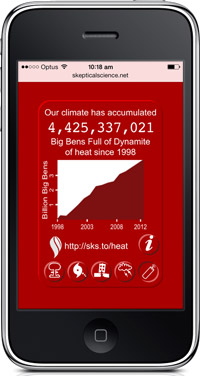
The numbers displayed by the widget counter are explained at the accompanying website, http://4hiroshimas.com/, and are based on that paper. There's also a Facebook app and an iPhone/iPad web app.
iPhone/iPad widget appiPhone/iPad widget app
Instructions for installing the widget and associated apps are provided in the links on the widget website.
With all these resources available to illustrate the rapid warming of the Earth's climate, hopefully we can once and for all put an end to the widespread misconceptions about the continued global warming. After all, we can't solve the problem until we stop denying that it exists.

SOURCE:http://www.theguardian.com/environment/climate-consensus-97-per-cent/2013/nov/25/global-warming-counter-widget

Sunday, November 17, 2013

El Nino may be partially responsible for global warming since 1950s

Washington: A new research has suggested that a natural shift to stronger warm El Nino events in the Pacific Ocean may be responsible for a substantial portion of the global warming recorded during the past 50 years. 

Lead author Dr. Roy Spencer , a principal research scientist in UAH's Earth System Science Center, said that their modelling shows that natural climate cycles explain at least part of the ocean warming they've seen since the 1950s. 

Spencer and co-author Dr. Danny Braswell used all of the usual climate modeling forcings - including carbon dioxide and other greenhouse gas enrichment - in their study, but also plugged the observed history of El Nino ocean warming and La Nina ocean cooling events into their model to calculate the 61-year change in global ocean temperature averages from the sea surface to a depth of 2,000 meters. 

When they ran their ocean model without ENSO, they arrived at the same general conclusions as the more complex general circulation climate models. 

When they added data from past El Nino and La Nina events as only a change in ocean mixing, the model indicated a climate system that is slightly less sensitive to CO2-induced warming than has been believed. 

But the biggest change was when the model was allowed to change cloud cover with El Nino and La Nina in the same way as has been observed from satellites. 

The results suggest that these natural climate cycles change the total amount of energy received from the sun, providing a natural warming and cooling mechanism of the surface and the deep ocean on multi-decadal time scales. 

Spencer said that as a result, because as much as 50 percent of the warming since the 1970s could be attributed to stronger El Nino activity, it suggests that the climate system is only about half as sensitive to increasing CO2 as previously believed. 

The study has been published in the Asia-Pacific Journal of Atmospheric Science. 

SOURCE:http://zeenews.india.com/news/space/el-nino-may-be-partially-responsible-for-global-warming-since-1950s_890435.html

Thursday, November 14, 2013

Global Warming Activism And Christianity: Beware Of Modern Inquisitors Toting Bibles

In the latest iteration of the mainstream media fawning over left wing activists disguised as conservative or mainstream Christian leaders, Tuesday’s Washington Post published a bizarre Op-ed by Susan Brooks Thistlethwaite, identifying herself as the past president of the Chicago Theological Seminary, saying it is “morally evil” for skeptics to disagree with her on global warming. For people of faith who may take a quick glance at Thistlethwaite’s asserted credentials and assume that she speaks for conservative or mainstream Christians and a Biblical point of view, beware of Thistlethwaite in sheep’s clothing.
For those who haven’t read Thistlethwaite’s editorial, it defines the terms incendiary and bizarre. In an editorial titled, “ ‘Super’ Typhoon Haiyan: Suffering and the sin of climate change denial,” Thistlethwaite claims Typhoon Haiyan was “evil” and the typhoon was caused by the twin “moral evils” of fossil fuel consumption and global warming skepticism. Affixing the deliberately insulting word “denial” to skeptics of the asserted global warming crisis, Thistlethwaite says this “denial” is a sin against God that requires confession, repentance and penance.
Inquisition, meet the twenty-first century.
Thistlethwaite did not mention whether she has any scientific education, training or expertise regarding the earth’s climate. Based on her failure to present any meaningful scientific argument in support of her religious condemnation of the conclusions drawn by scientists at such institutions as NASA, NOAA, Harvard, Princeton, etc., I am guessing it is essentially nonexistent. This is an important point because any assertion of a religious duty to oppose the use of fossil fuels depends on the prerequisite scientific assertion that humans are causing a global warming crisis that is responsible for Typhoon Haiyan and other “evil” natural weather events.
Given the number of times I have presented in this column the objective data showing hurricanes are becoming less frequent and less severe as our planet warms, I will merely link to a summary of suchscientific evidence here. The point is, the issue is one of science, not religion, and the scientific evidence is strong that global warming is having a neutral or beneficial impact on hurricanes. Thisthlethwaite’s attempt to force people in the Philippines and elsewhere to use expensive, non-fossil fuel energy sources – if any energy sources at all – merely impoverishes people, creating unnecessary human misery and leaving little wealth available to build storm-worthy houses and infrastructure that can save lives when typhoons occur.
If we accept Thistlethwaite’s dubious premise that it is morally evil and a sin against God to misunderstand science or to form the wrong conclusion about how to best reduce human misery, then Thistlethwaite better hope God is a very forgiving God.
Which brings us back to Thistlethwaite’s asserted theological credentials that apparently convinced the Post to publish her Op-ed. The mainstream media love to call attention to global warming activists who have some connection to religion and then falsely portray them as representing the Biblical interpretations of conservative or mainstream Christian leaders. Thistlethwaite and the Washington Post are no exception to the rule.
Thistlethwaite’s greatest claim to fame is authoring the book “Occupy the Bible,” in which she claims Jesus was anti-capitalist. She urges present-day anti-capitalists to “occupy” Christianity the way the socialist Occupy movement took over street intersections and public parks. For people of faith who witnessed the rapes, drug abuse and trashing of public property at the sites taken over by the Occupy movement, this is a frigthening thought.
Thistlethwaite’s revisionist theological assertions in “Occupy the Bible” are astounding. Mark 11:17 states, “Is it not written: ‘My house will be called a house of prayer for all nations, but you have made it ‘a den of robbers.’” According to Thistlethwaite’s book promo, however, this was designed to be anti-capitalist political agitation: “Jesus occupied the Temple in Jerusalem—effectively the national bank of his time—and threw out those who were exploiting the poor.” In the gospel according to Thistlethwaite, Jesus was less concerned about preserving the religious purity of prayer at the Temple and more concerned about making a statement about the moneyed classes sticking it to the poor through capitalism. (And even if you believe that religious whopper, don’t socialist nations have money exchanges, too?)
Similarly, Thistlethwaite downplays the religious meaning of Jesus calling Andrew, Peter, John and James to be his disciples and invents an anti-capitalist agenda. According to her book promo, “Jesus organized fishermen whose industry had been wrecked by the Roman Empire .”
While Thistlethwaite directs so much attention to her revisionist interpretation of Jesus clearing the Temple courts and calling his apostles to be fishers of men, perhaps she might want to consider Matthew 7:15: “Beware of false prophets. They come to you in sheep’s clothing, but inwardly they are ferocious wolves.”
Thistlethwaite extends her revisionist theology in other columns for the Post, with such titles as, “We need a new Social Gospel: the moral imperative of collective bargaining,” “The right’s war on poor women” and “Does nuclear power usurp the power of God?”
Thistlethwaite can interpret – or misinterpret – scripture all she wants. However, people of faith should know upfront that Thistlethwaite does not represent conservative or mainstream Christian leaders when they read her column calling it morally evil to use fossil fuels and morally evil to subject alarmist global warming claims to the Scientific Method.
By the way, given how Thistlethwaite calls it a moral evil to use fossil fuels, I am wondering whether she owns a car, rides a bus, flies on airplanes or uses electricity in her home. Unless she rides a bicycle to work and writes her Op-eds by typewriter and candlelight, I think she might want to read Matthew 7:5 before calling the use of fossil fuels morally evil.
On a deeper plane, does Thistlethwaite really believe God is honored and pleased when she applies the “morally evil” label to sincere, God-worshipping Christians – many of whom have substantially more extensive scientific education and training than her – for merely disagreeing with her lay interpretation of climate science?
Not that Thistlethwaite’s Chicago Theological Seminary is any more representative of conservative or mainstream Christian thought. In the Seminary’s 564-word “Philosophy” webpage, there is not a single mention of spreading the good news about the life, death and resurrection of Jesus. Instead, the Seminary’s Philosophy webpage provides a long and detailed manifesto of leftist liberation theology, castigating our nation for being “a society riven by racism” and “threatened by new forces of division under the banner of homophobia.” Apparently division and name-calling under the banner of global warming activism is nevertheless desirable.
In short, Thistlethwaite may be a past president of a seminary that advocates leftist liberation theology, but this doesn’t give her any semblance of leadership or representation of conservative or mainstream Christian thought. Moreover, her condemnation and insulting rhetoric directed at skeptics of her asserted global warming crisis have no religious, scientific or moral weight.

Tuesday, November 12, 2013

Cosmic rays fall cosmically behind humans in explaining global warming

A man gazes at the Milky Way outside his house at night
Cosmic rays sound like an elegant explanation for global warming, but the hypothesis hasn't withstood scientific scrutiny. Photograph: Alamy
For climate skeptics trying to find an alternative explanation for the global warming that's occurred over the past century, the sun and galactic cosmic rays have become a popular hypothesis. However, several recent scientific papers have effectively put the final nail in the cosmic rays-global warming coffin.

Galactic cosmic rays
 are high energy particles originating from outside our solar system. Henrik Svensmark of the Danish National Space Institute is the main proponent of the hypothesis linking them to globalclimate change. The hypothesis goes like this:
1) Cosmic rays may be able to seed cloud formation.
2) If so, fewer cosmic rays reaching Earth means less cloud formation.
3) Fewer clouds reflecting sunlight means more solar radiation reaching the Earth's surface, and thus warming.
The sun's magnetic field deflects galactic cosmic rays, so if the sun is in a phase of high activity with a strong magnetic field, fewer cosmic rays will reach Earth. Hence if this hypothesis is correct, galactic cosmic rays will act to amplify the solar influence on the global climate, whether it be a cooling effect from low solar activity or warming from high solar activity.
This is a relatively new and interesting hypothesis, so it's become popular amongst climate contrarians as an alternative explanation to human-caused global warming. However, it's also been the subject of extensive scientific research over the past few years, and the hypothesis simply has not held up to scrutiny.
First, there's the obvious fact that cosmic rays cannot explain the recent global warming because solar activity and the amount of cosmic rays reaching the Earth's surface have remained flat on average over the past 60 years. The sun and cosmic rays could only be causing global warming if there were a long-term upward trend in solar activity and downward trend in cosmic rays reaching Earth. In fact, the number of cosmic rays reaching Earth has increased since 1990, and reached record levels in 2009 (one of the hottest years on record).
Annual average cosmic ray counts per minute (blue - note that numbers decrease going up the left vertical axis, because lower cosmic rays should mean higher temperatures) from the Neutron Monitor Database vs. annual average global surface temperature (red, right vertical axis) from NOAA, both with second order polynomial fits. Annual average cosmic ray counts per minute (blue - note that numbers decrease going up the left vertical axis, because lower cosmic rays should mean higher temperatures) from the Neutron Monitor Database vs. annual average global surface temperature (red, right vertical axis) from NOAA.
A paper published in the journal Meteorology and Atmospheric Physics this August noted,
"Recent measurements of the cosmic ray intensity show that … even if cosmic rays enhanced cloud production, there would be a small global cooling, not warming."
Two of the authors of that paper (Sloan & Wolfendale) have also just published another cosmic ray research paper in Environmental Research Letters, finding that the contribution of solar activity and galactic cosmic rays (combined) to global warming is "less than 10% of the warming seen in the twentieth century."
Sloan & Wolfendale also examine the influence of cosmic rays on the climate over the past billion years in another new paper published in the journal New Astronomy. They find that changes in the galactic cosmic ray intensity are too small to account for significant climate changes on Earth. This was also the conclusion of a paper published this May in The Astrophysical Journal.
In another paper just recently published in Environmental Research Letters, Rasmus Benestad of The Norwegian Meteorological Institute compares measured changes in the amount of cosmic rays reaching Earth to changes in temperature, precipitation, and barometric pressure measurements. Benestad finds no statistical evidence that cosmic rays can explain the recent global warming.
Finally, a paper published last month in Geophysical Research Letterscompared measurements of cosmic rays and cloud cover changes, and found no detectable connection between the two. This study is consistent with many previous papers finding that cosmic rays are not effective at seeding clouds.
Thus every step in the galactic cosmic ray-climate hypothesis is fraught with problems. Evidence suggests that cosmic rays are not effective at seeding clouds. Solar activity has been flat, and even slightly downwards over the past few decades. Galactic cosmic ray flux on Earth has been flat, even slightly upwards over the past few decades. 2009, which saw a record number of cosmic rays reaching Earth (meaning it should have been cold), was the 5th-hottest year on record at the time.
This failed hypothesis offers a stark contrast to the overwhelming consensus that our greenhouse gas emissions are driving warming. The latter is supported by solid, well-understood fundamental physics. We know that increasing the greenhouse effect causes more energy to be trapped on Earth, and that energy has to go somewhere. The observed pattern of warming is precisely what we expect to see from an increased greenhouse effect, for example with the 'fingerprint' of a cooling upper atmosphere due to more heat being trapped in the lower atmosphere.
There is overwhelming evidence supporting human-caused global warming, which is why it's supported by a 97 percent expert consensus. Science progresses through constant testing of new ideas. Those that fail to withstand scrutiny, like a significant galactic cosmic ray climate influence, fall by the wayside. Those that hold up to our growing scientific understanding eventually convince the naturally skeptical scientific community and become the expert consensus view.

SOURCE:http://www.theguardian.com/environment/climate-consensus-97-per-cent/2013/nov/12/global-warming-humans-not-cosmic-rays

Monday, October 28, 2013

IPCC model global warming projections have done much better than you think

Global warming since 1990 has fallen within the range of IPCC climate model projections
IPCC Earth
Models that simulate the Earth's climate are constantly improving. Photograph: NASA/Corbis
The figure below from the 2013 Intergovernmental Panel on Climate Change (IPCC) report compares the global surface warming projections made in the 1990, 1995, 2001, and 2007 IPCC reports to the temperature measurements.
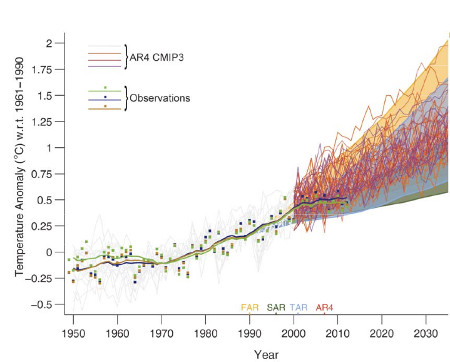
IPCC AR5 Figure 1.4.  Solid lines and squares represent measured average global surface temperature changes by NASA (blue), NOAA (yellow), and the  UK Hadley Centre (green).  The colored shading shows the projected range of surface warming in the IPCC First Assessment Report (FAR; yellow), Second (SAR; green), Third (TAR; blue), and Fourth (AR4; red).IPCC AR5 Figure 1.4. Solid lines and squares represent measured average global surface temperature changes by NASA (blue), NOAA (yellow), and the UK Hadley Centre (green). The colored shading shows the projected range of surface warming in the IPCC First Assessment Report (FAR; yellow), Second (SAR; green), Third (TAR; blue), and Fourth (AR4; red).
Since 1990, global surface temperatures have warmed at a rate of about 0.15°C per decade, within the range of model projections of about 0.10 to 0.35°C per decade. As the IPCC notes,
"global climate models generally simulate global temperatures that compare well with observations over climate timescales ... The 1990–2012 data have been shown to be consistent with the [1990 IPCC report] projections, and not consistent with zero trend from 1990 ... the trend in globally-averaged surface temperatures falls within the range of the previous IPCC projections."

What about the Naysayers?

In the weeks and months leading up to the publication of the final 2013 IPCC report, there has been a flood of opinion articles in blogs and the mainstream media claiming that the models used by the IPCC have dramatically over-predicted global warming and thus are a failure. This narrative clearly conflicts with the IPCC model-data comparison figure shown above, so what's going on?
These mistaken climate contrarian articles have all suffered from some combination of the following errors.

1) Publicizing the flawed draft IPCC model-data comparison figure

Late last year, an early draft of the IPCC report was leaked, including the first draft version of the figure shown above. The first version of the graph had some flaws, including a significant one immediately noted by statistician and climate blogger Tamino.
"The flaw is this: all the series (both projections and observations) are aligned at 1990. But observations include random year-to-year fluctuations, whereas the projections do not because the average of multiple models averages those out ... the projections should be aligned to the value due to the existing trend in observations at 1990.
Aligning the projections with a single extra-hot year makes the projections seem too hot, so observations are too cool by comparison."
In the draft version of the IPCC figure, it was simply a visual illusion that the surface temperature data appeared to be warming less slowly than the model projections, even though the measured temperature trend fell within the range of model simulations. Obviously this mistake was subsequently corrected.
This illustrates why it's a bad idea to publicize material in draft form, which by definition is a work in progress. That didn't stop Fox NewsRoss McKitrick in the Financial PostRoger Pielke Jr., the Heartland Institute, and Anthony Watts from declaring premature and unwarranted victory on behalf of climate contrarians based on the faulty draft figure.

2) Ignoring the range of model simulations

A single model run simulates just one possible future climate outcome. In reality, there are an infinite number of possible outcomes, depending on how various factors like greenhouse gas emissions and natural climate variability change. This is why climate modelers don't make predictions; they make projections, which say in scenario 'x', the climate will change in 'y' fashion. The shaded regions in the IPCC figure represent the range of outcomes from all of these individual climate model simulations.
The IPCC also illustrates the "multi-model mean," which averages together all of the individual model simulation runs. This average makes for an easy comparison with the observational data; however, there's no reason to believe the climate will follow that average path, especially in the short-term. If natural factors act to amplify human-caused global surface warming, as they did in the 1990s, the climate is likely to warm faster than the model average in the short-term. If natural factors act to dampen global surface warming, as they have in the 2000s, the climate is likely to warm more slowly than the model average.
When many model simulations are averaged together, the random natural variability in the individual model runs cancel out, and the steady human-caused global warming trend remains left over. But in reality the climate behaves like a single model simulation run, not like the average of all model runs.
This is why it's important to retain the shaded range of individual model runs, unlike Bjorn Lomborg in The AustralianJudith Curry in The AustralianBenny Peiser at GWPFRoger Pielke Jr.David Rose in the Mail on Sunday (copied by Hayley Dixon in The Telegraph), and Der Spiegel, all of whom only considered the model average.
This group all made an additional related third error as well.

3) Cherry Picking

Most claims that the IPCC models have failed are based on surface temperature changes over the past 15 years (1998–2012). During that period, temperatures have risen about 50 percent more slowly than the multi-model average, but have remained within the range of individual model simulation runs.
However, 1998 represented an abnormally hot year at the Earth's surface due to one of the strongest El NiƱo events of the 20th century. Thus it represents a poor choice of a starting date to analyze the surface warming trend (selectively choosing convenient start and/or end points is also known as 'cherry picking'). For example, we can select a different 15-year period, 1992–2006, and find a surface warming trend nearly 50 percent faster than the multi-model average, as statistician Taminohelpfully illustrates in the figure below.
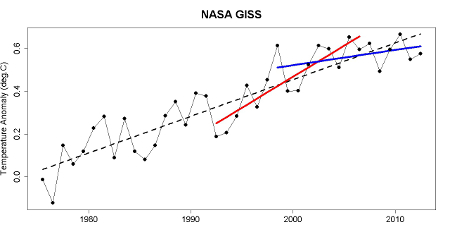
Fast warming trend 1992–2006, slow warming trend 1997–2012Global surface temperature data 1975–2012 from NASA with a linear trend (black), with trends for 1992–2006 (red) and 1998–2012 (blue).
In short, if David Rose wasn't declaring that global surface warming was accelerating out of control in 2006, then he has no business declaring that global surface warming has 'paused' in 2013. Both statements are equally wrong, based on cherry picking noisy short-term data.

IPCC models have been accurate

For 1992–2006, the natural variability of the climate amplified human-caused global surface warming, while it dampened the surface warming for 1997–2012. Over the full period, the overall warming rate has remained within the range of IPCC model projections, as the 2013 IPCC report notes.
"The long-term climate model simulations show a trend in global-mean surface temperature from 1951 to 2012 that agrees with the observed trend (very high confidence). There are, however, differences between simulated and observed trends over periods as short as 10 to 15 years (e.g., 1998 to 2012)."
The IPCC also notes that climate models have accurately simulated trends in extreme cold and heat, large-scale precipitation pattern changes, and ocean heat content (where most global warming goes). Models also now better simulate the Arctic sea ice decline, which they had previously dramatically underestimated.
All in all, the IPCC models do an impressive job accurately representing and projecting changes in the global climate, contrary to contrarian claims. In fact, the IPCC global surface warming projections haveperformed much better than predictions made by climate contrarians.
It's important to remember that weather predictions and climate predictions are very different. It's harder to predict the weather further into the future. With climate predictions, it's short-term variability (like unpredictable ocean cycles) that makes predictions difficult. They actually do better predicting climate changes several decades into the future, during which time the short-term fluctuations average out.
That's why climate models have a hard time predicting changes over 10–15 years, but do very well with predictions several decades into the future, as the IPCC illustrates. This is good news, because with climate change, it's these long-term changes we're worried about:
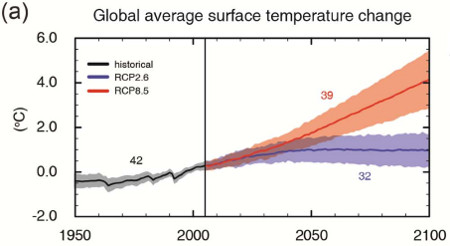
IPCC surface temperature change projectionsIPCC AR5 projected global average surface temperature changes in a high emissions scenario (RCP8.5; red) and low emissions scenario (RCP2.6; blue).